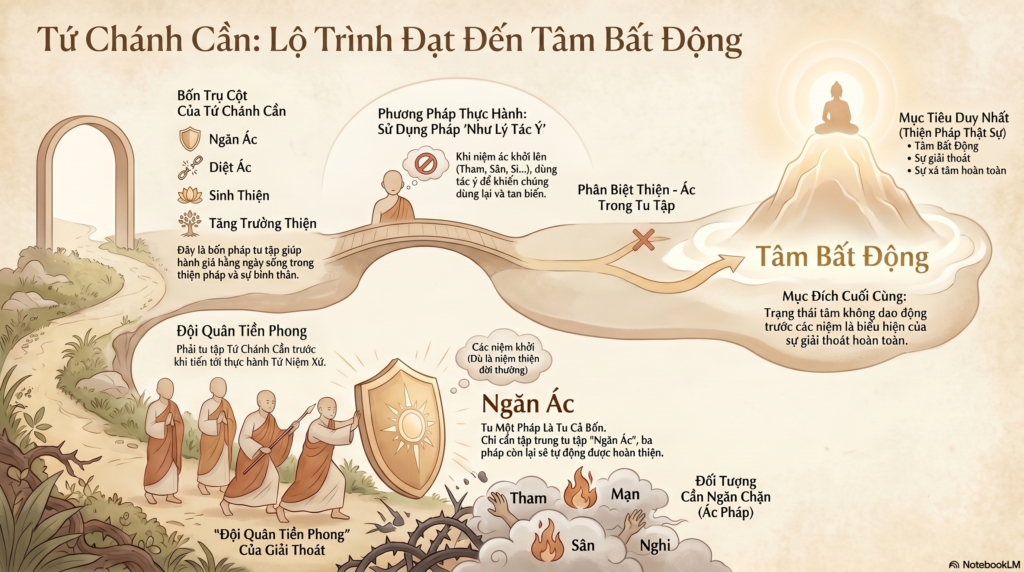
Tứ Chánh Cần gồm có:
1- Ngăn ác pháp
2- Diệt ác pháp
3- Sinh thiện pháp
4- Tăng trưởng thiện pháp
Trên đây là bốn pháp tu tập của pháp môn Tứ Chánh Cần. Pháp môn Tứ Chánh Cần là pháp môn thứ năm của Phật giáo, theo lời dạy của đức Phật còn ghi lại trong kinh sách Nguyên Thủy.
Bốn pháp này rất quan trọng trong sự tu tập theo Phật giáo. Đây là một phương pháp giúp cho người tu sĩ Phật giáo hằng ngày sống trong thiện pháp, sống trong tâm BẤT ĐỘNG.
Ai cũng biết mục đích của Phật giáo là sống trong tâm Bất Động. Muốn tâm Bất Động thì hằng giây, hằng phút, hằng giờ, hằng ngày phải siêng năng tu tập NGĂN ÁC. Ngăn ác pháp tức là ngăn từng tâm niệm THAM, SÂN, SI, MẠN, NGHI, khi có niệm khởi lên trong tâm thì hãy mau mau dùng pháp NHƯ LÝ TÁC Ý làm cho niệm đó dừng lại và tan biến mất. Khi niệm đó dừng lại và tan biến mất thì để lại một khoảng thời gian ngắn trong tâm Bất Động rồi có niệm khác khởi lên, khi có niệm khác khởi lên như vậy thì chúng ta lại tác ý ngăn chặn niệm ấy, thì niệm ấy dừng lại và tan biến mất, lúc bấy giờ để lại cho tâm chúng ta Bất Động một khoảng thời gian ngắn nữa.
Hằng ngày chúng ta chỉ cần tu tập một pháp Ngăn Ác, là có đủ ba pháp DIỆT ÁC, SINH THIỆN, TĂNG TRƯỞNG THIỆN PHÁP. Cho nên tu tập Tứ Chánh Cần không phải tu cả bốn pháp, mà chỉ tu tập một pháp mà thôi.
Khi vào tu tập, chúng ta nên lấy pháp môn đầu tiên của Tứ Chánh Cần mà tu tập, đó là pháp môn NGĂN ÁC.
Ngăn Ác tức là ngăn các niệm khởi, nhưng trong tâm chúng ta có niệm thiện khởi thì chúng ta phải làm sao?
Dù niệm đó thiện, nhưng vì tâm chúng ta chưa ly dục, ly ác pháp hết, nên thiện đó vẫn còn là ác pháp, chớ không phải là thiện pháp thật sự.
Hiện giờ trong tâm chúng ta có một niệm thiện duy nhất, đó là niệm thiện TÂM BẤT ĐỘNG. Cho nên trong pháp môn Tứ Chánh Cần dạy SINH THIỆN TĂNG TRƯỞNG THIỆN, tức là niệm thiện Tâm Bất Động. Niệm này thì không nên diệt, mà phải tăng trưởng sống cho được với Tâm Bất Động này, còn tất cả niệm thiện khác đều diệt sạch. Nhưng khi tâm khởi ra niệm thì phải mau mau đình chỉ không cho chúng hoạt động, do ngăn các niệm khởi nên tâm sẽ Bất Động.
Tâm sẽ Bất Động là chúng ta đã đạt được mục đích giải thoát của Phật giáo. Vì thế, chúng ta chỉ cần tu một pháp mà thôi, pháp Ngăn Ác là đủ rồi. Cho nên nói tu tập Tứ Chánh Cần, chớ thực ra chỉ có tu tập pháp NGĂN ÁC. Pháp Ngăn Ác là pháp đầu tiên trong bốn pháp của pháp môn Tứ Chánh Cần. Xin quý vị lưu ý trong khi tu tập pháp môn này.
Con đường tu tập theo Phật giáo, nếu không tu tập pháp môn Tứ Chánh Cần thì không bao giờ tu tập pháp nào có giải thoát cả, vì pháp môn Tứ Chánh Cần rất quan trọng, nó là đệ nhất pháp XẢ TÂM của Phật giáo. Cho nên những ai không tu tập Tứ Chánh Cần, mà tu tập các pháp môn khác là không biết đường lối tu tập của Phật giáo. Không biết đường lối của Phật giáo, mà tu tập thì tu tập sai, làm mất căn bản con đường tu tập của mình.
Pháp môn Tứ Chánh Cần như đội quân tiền phong, luôn luôn đi trước, khai sơn, phá thạch để cho cả một quân đoàn thiện chiến tiến sâu vào căn cứ giặc, nhờ đó nó mới san bằng những căn cứ của giặc để TỨ NIỆM XỨ đến thành lập chánh quyền cai trị.
Cho nên những ai tu tập pháp môn Tứ Niệm Xứ, mà chưa tu tập pháp môn Tứ Chánh Cần là không biết đường lối tu tập. Tu như vậy là sai, chẳng bao giờ có giải thoát, vì tu lộn ngược pháp, pháp trước ra sau, pháp sau ra trước.
Xin lưu ý quý vị, pháp môn Tứ Chánh Cần bao giờ cũng tu tập trước pháp môn Tứ Niệm Xứ.
Theo: 37 phẩm trợ đạo (trưởng lão Thích Thông Lạc)
The Four Right Efforts consist of:
- Preventing unwholesome states (Ngăn ác pháp)
- Abandoning unwholesome states (Diệt ác pháp)
- Cultivating wholesome states (Sinh thiện pháp)
- Maintaining and increasing wholesome states (Tăng trưởng thiện pháp)
These are the four practices of the Four Right Efforts. The Four Right Efforts is the fifth Dharma practice in Buddhism, according to the teachings of the Buddha recorded in the Early Buddhist scriptures.
These four practices are crucial in Buddhist cultivation. This is a method that helps Buddhist practitioners live daily in wholesome states, living with an UNSHAKEABLE mind.
It is well known that the goal of Buddhism is to live with an Unshakeable mind. To achieve this Unshakeable mind, one must diligently practice PREVENTING UNWHOLESOME STATES every second, minute, hour, and day. Preventing unwholesome states means stopping every single thought of GREED, HATRED, DELUSION, CONCEIT, and DOUBT. When such a thought arises in the mind, one must quickly use WISE ATTENTION to make it stop and vanish. Once that thought stops and vanishes, it leaves a brief period of an Unshakeable mind before another thought arises. When another thought arises, we again use attention to block it, making it stop and vanish, which then leaves our mind Unshakeable for another brief period.
Daily, we only need to practice the single method of Preventing Unwholesome States, and it will encompass the other three: ABANDONING UNWHOLESOME STATES, CULTIVATING WHOLESOME STATES, and INCREASING WHOLESOME STATES. Therefore, practicing the Four Right Efforts does not mean practicing all four simultaneously, but rather focusing solely on one.
When beginning the practice, we should take the first method of the Four Right Efforts, which is PREVENTING UNWHOLESOME STATES.
Preventing Unwholesome States means stopping arising thoughts, but what should we do if a wholesome thought arises in our mind?
Even if the thought is wholesome, because our minds are not yet entirely free from desires and unwholesome qualities, that “wholesomeness” still contains unwholesome aspects; it is not truly wholesome.
Currently, there is only one truly wholesome state in our mind: the UNSHAKEABLE MIND. Therefore, when the Four Right Efforts teach CULTIVATING AND INCREASING WHOLESOME STATES, it refers precisely to this Unshakeable Mind. This state should not be abandoned; rather, we must increase it and manage to live with this Unshakeable Mind, while all other wholesome thoughts should be completely eradicated. However, whenever the mind gives rise to a thought, we must quickly halt it and prevent its activity. By stopping arising thoughts, the mind becomes Unshakeable.
When the mind becomes Unshakeable, we have achieved the Buddhist goal of liberation. Hence, practicing just one method—Preventing Unwholesome States—is sufficient. So, while we say we are practicing the Four Right Efforts, in reality, we are primarily practicing PREVENTING UNWHOLESOME STATES. Preventing Unwholesome States is the first of the four practices within the Four Right Efforts. Please keep this in mind while engaging in this practice.
On the Buddhist path of cultivation, if one does not practice the Four Right Efforts, no other practice will ever lead to liberation, because the Four Right Efforts is incredibly important; it is the foremost method of LETTING GO of the mind in Buddhism. Therefore, those who skip the Four Right Efforts to practice other methods do not truly understand the Buddhist path. Practicing without knowing the path leads to wrong practice, causing one to lose the foundation of their spiritual journey.
The Four Right Efforts act like a vanguard army, always leading the way, clearing mountains and breaking rocks, allowing a well-trained legion to advance deep into the enemy’s base. Thanks to this, it levels the enemy’s strongholds so that the FOUR FOUNDATIONS OF MINDFULNESS can arrive and establish governance.
Thus, anyone who practices the Four Foundations of Mindfulness without first practicing the Four Right Efforts does not understand the path. Such practice is incorrect and will never lead to liberation, because it reverses the order of the teachings—putting what should come first last, and what should come last first.
Please note that the Four Right Efforts must always be practiced before the Four Foundations of Mindfulness.
💡 Bảng thuật ngữ hữu ích (Glossary of Terms)
Để hỗ trợ việc dịch thuật các văn bản mang tính khái niệm phức tạp tương tự, dưới đây là một số thuật ngữ Phật giáo Nguyên thủy bằng tiếng Anh đã được sử dụng:
- Tứ Chánh Cần: The Four Right Efforts (hoặc The Four Right Exertions). Thuật ngữ Pali là Sammappadhāna.
- Ác pháp: Unwholesome states / Unskillful qualities.
- Thiện pháp: Wholesome states / Skillful qualities.
- Tâm Bất Động: Unshakeable mind / Immovable mind / Unperturbed mind.
- Tham, Sân, Si, Mạn, Nghi: Greed, Hatred (hoặc Anger), Delusion, Conceit (hoặc Pride), Doubt.
- Như lý tác ý: Wise attention / Appropriate attention. Thuật ngữ Pali là Yoniso Manasikara.
- Ly dục, ly ác pháp: Free from desires and unwholesome qualities.
- Tứ Niệm Xứ: The Four Foundations of Mindfulness. Thuật ngữ Pali là Satipatthana.
- Pháp Xả tâm: The practice of Letting go / Relinquishment of mind.
- Kinh sách Nguyên Thủy: Early Buddhist scriptures / Theravada texts.