Tứ Như Ý Túc gồm có:
1- Định Như Ý Túc
2- Tinh Tấn Như Ý Túc
3- Tuệ Như Ý Túc
4- Dục Như Ý Túc
Trên đây là bốn pháp của Tứ Như Ý Túc. Pháp môn này là pháp môn thứ tám của Phật giáo, theo lời dạy của đức Phật còn ghi lại trong kinh Nguyên Thủy.
Tổng cộng lại tất cả các pháp tu tập của đạo Phật, là chúng ta có đúng BA MƯƠI BẢY PHÁP MÔN. Ngoài ba mươi bảy pháp môn này, để thực hiện trọn đủ trong chương trình BÁT CHÁNH ĐẠO thì không còn pháp môn nào khác nữa, xin quý vị lưu ý, đừng để giáo pháp ngoại đạo lừa đảo.
Đạo Phật chỉ có ba mươi bảy pháp môn tu tập này mà thôi, nó không còn một pháp môn nào khác nữa. Nếu còn có pháp môn nào ngoài ba mươi bảy pháp pháp môn này thì đó là pháp môn của ngoại đạo.
Bởi vậy Phật giáo có pháp môn riêng của Phật giáo mà ngoại đạo không bao giờ có những pháp môn ấy, cho nên ngoại đạo không thể nào mạo nhận pháp môn của mình là pháp môn của Phật giáo được. Kinh sách Đại thừa và kinh sách Thiền tông muốn mạo nhận những kinh sách này là của Phật thuyết, nhưng không làm sao được, nên Đại thừa và Thiền tông mới nghĩ ra phương cách gạt tín đồ bằng cách dựng lên những trang Thiền sử có 33 vị tổ sư thiền Ấn Độ và Trung Quốc. Kinh sách Đại thừa và Thiền tông làm trái ngược lại với lời di chúc của đức Phật trước khi nhập Niết Bàn: “Này các thầy tỳ kheo, sau khi Ta nhập diệt, các thầy tỳ kheo hãy lấy GIỚI LUẬT và giáo pháp (TỨ NIỆM XỨ) của Ta làm thầy, làm chỗ nương tựa vững chắc, không nương tựa một điều gì khác, đừng lấy ai làm thầy cả”. Kinh sách phát triển làm sao gạt được, khi kinh sách Nguyên Thủy còn ghi lại lời di chúc đó. Ba mươi bảy pháp môn của Phật còn kia, thì bộ mặt dối trá bị lật tẩy quý vị có thấy không?
Quý vị cũng biết, kinh sách phát triển Đại thừa và kinh sách Tối Thượng thừa của Thiền tông Trung Hoa cố ý mạo nhận là Phật thuyết, nên xếp kinh A Hàm – những lời đức Phật dạy vào hàng Tiểu thừa để lừa đảo mọi người. Nhưng khi đọc kinh Nikaya nguyên gốc của Phật, mới biết Đại thừa và Tối Thượng thừa là kinh sách của Phật giáo Trung Quốc, chịu ảnh Khổng giáo và Lão giáo rất nặng, cho nên kinh sách phát triển và kinh sách Tối Thượng thừa không còn là Phật giáo nguyên thủy.
Kinh sách phát triển và kinh sách Tối Thượng thừa tu hành không bao giờ làm chủ SINH, GIÀ, BỆNH, CHẾT. Cho nên kinh sách này không bao giờ dám đả động đến việc tu tập làm chủ sinh tử và chấm dứt luân hồi.
Theo: 37 phẩm trợ đạo (trưởng lão Thích Thông Lạc)
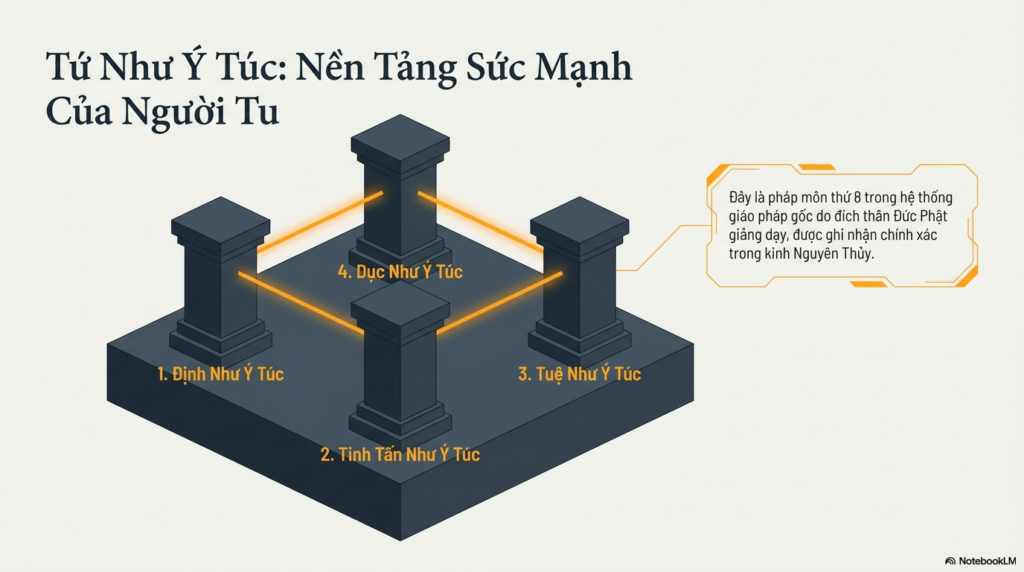
The Four Bases of Power consist of:
- The Base of Power of Concentration (Định Như Ý Túc)
- The Base of Power of Energy (Tinh Tấn Như Ý Túc)
- The Base of Power of Investigation (Tuệ Như Ý Túc)
- The Base of Power of Desire/Will (Dục Như Ý Túc)
These are the four practices of the Four Bases of Power. This is the eighth practice of Buddhism, according to the teachings of the Buddha recorded in the Early Buddhist scriptures.
In total, adding up all the practices of Buddhism, we find exactly THIRTY-SEVEN FACTORS OF ENLIGHTENMENT (Bodhipakkhiyadhamma). Apart from these thirty-seven factors, there are no other practices to fully realize the program of the NOBLE EIGHTFOLD PATH. Please take note of this; do not let the teachings of non-Buddhist traditions deceive you.
Buddhism possesses only these thirty-seven practices and nothing more. If any practice exists outside of these thirty-seven, it belongs to non-Buddhist traditions.
Therefore, Buddhism has its own unique practices that non-Buddhist traditions never possess; hence, they cannot falsely claim their methods as Buddhist ones. Mahayana and Zen Buddhist texts attempt to claim they were spoken by the Buddha, but to no avail. Consequently, Mahayana and Zen traditions devised a way to deceive followers by inventing “Zen histories” featuring 33 Indian and Chinese Zen Patriarchs. These Mahayana and Zen scriptures act in direct opposition to the Buddha’s final testament before entering Parinirvana: “Monks, after my passing, let the PRECEPTS and my Dhamma (the FOUR FOUNDATIONS OF MINDFULNESS) be your teacher, your firm refuge. Do not seek refuge in anything else; do not take anyone else as your teacher.” How can these later developed scriptures deceive anyone when the Early Buddhist scriptures still preserve that final testament? With the Buddha’s thirty-seven practices still present, their deceptive mask is uncovered—can you see it?
As you know, the Mahayana developed scriptures and the “Supreme Vehicle” texts of Chinese Zen intentionally falsely claim to be the Buddha’s words. They categorize the Agama sutras—the actual words taught by the Buddha—as “Hinayana” (Small Vehicle) to deceive people. However, upon reading the original Nikaya scriptures of the Buddha, one realizes that Mahayana and the Supreme Vehicle are products of Chinese Buddhism, heavily influenced by Confucianism and Taoism. Therefore, these developed and Supreme Vehicle scriptures are no longer Early Buddhism.
Practitioners of the developed and Supreme Vehicle scriptures can never master BIRTH, AGING, SICKNESS, and DEATH. Thus, these scriptures never dare to address the actual practice of mastering life and death or ending the cycle of reincarnation (Samsara).
💡 Thuật ngữ bổ sung (Additional Terms)
Các thuật ngữ quan trọng trong đoạn này:
- Tứ Như Ý Túc: The Four Bases of Power (hoặc The Four Bases of Spiritual Power).
- Ba mươi bảy pháp môn (Ba mươi bảy phẩm trợ đạo): The Thirty-seven Factors of Enlightenment (Bodhipakkhiyadhamma).
- Ngoại đạo: Non-Buddhist traditions / External paths.
- Kinh sách Đại thừa: Mahayana scriptures.
- Kinh sách Thiền tông: Zen/Chan Buddhist scriptures.
- Tổ sư thiền: Zen Patriarchs.
- Nhập Niết Bàn: Entering Parinirvana / Passing away.
- Làm chủ Sinh, Già, Bệnh, Chết: Mastering Birth, Aging, Sickness, and Death.
- Chấm dứt luân hồi: Ending the cycle of reincarnation / Ending Samsara.
- Kinh sách phát triển: Developed scriptures (thường dùng để chỉ kinh điển Bắc truyền/Mahayana).