Tứ Bất Hoại Tịnh gồm có:
1- Niệm Phật
2- Niệm Pháp
3- Niệm Tăng
4- Niệm Giới
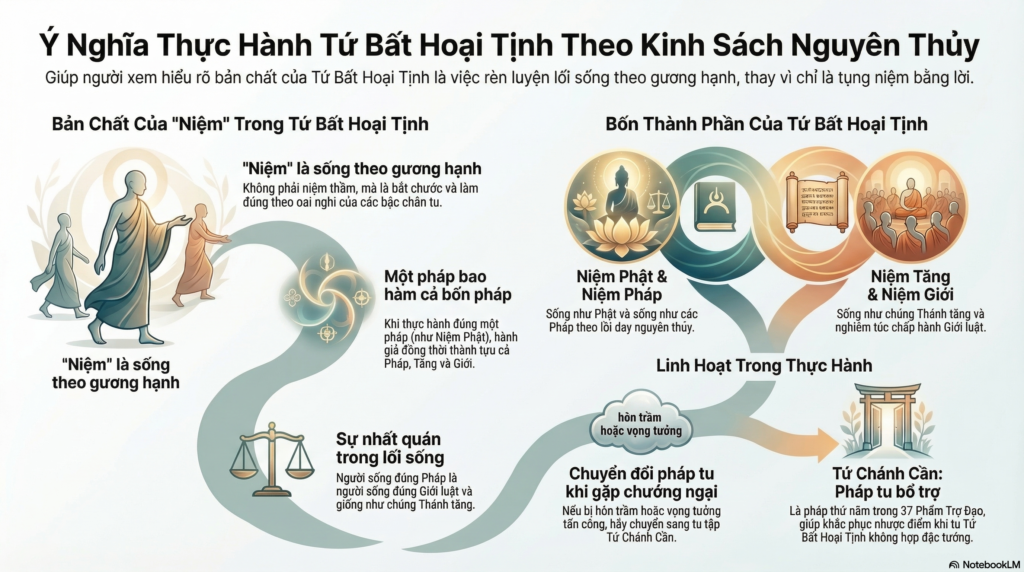
Trên đây là bốn pháp Bất Hoại Tịnh, pháp thứ tư của Phật giáo, theo lời dạy của Phật còn ghi lại trong kinh sách Nguyên Thủy. Bốn pháp niệm Phật này không giống pháp môn niệm Phật trong kinh sách Đại thừa. Bốn pháp môn niệm Phật này dạy chúng ta sống như Phật, sống như các Pháp, sống như chúng Thánh tăng đệ tử của Phật và sống như Giới luật.
Chữ niệm ở đây không có nghĩa là niệm lầm thầm trong miệng, mà chữ niệm ở đây có nghĩa là bắt chước, làm theo từng hành động cho đúng những oai nghi chánh hạnh của những bậc chân tu.
Trong bốn pháp môn này cũng là một chùm pháp, nếu chúng ta chỉ cần tu một pháp trong bốn pháp này thì cũng thành tựu luôn cả ba pháp kia, vì một pháp là cả bốn pháp.
Ví dụ: Tu tập pháp thứ nhất là NIỆM PHẬT trong pháp môn Tứ Bất Hoại Tịnh, thì cũng giống như tu tập NIỆM PHÁP, NIỆM TĂNG và NIỆM GIỚI. Cho nên tuy nói là bốn pháp, có bốn tên khác nhau, nhưng khi thực hành thì trong bốn pháp này không khác nhau. Niệm Phật cũng giống như Niệm Pháp, Niệm Pháp cũng giống như Niệm Tăng, Niệm Tăng cũng giống như Niệm Giới, vì Phật sống như Pháp, như Giới và như chúng Thánh tăng. Cho nên người sống giống như Phật là người sống không sai Pháp, người sống không sai Pháp là người sống không sai khác chúng Thánh tăng; sống không sai khác chúng Thánh tăng là sống đúng Giới luật.
Muốn tu tập pháp môn Niệm Phật Tứ Bất Hoại Tịnh thì chỉ tu một pháp môn NIỆM PHẬT mà thành tựu bốn pháp: niệm Phật, niệm Pháp, niệm Tăng, niệm Giới.
Khi tu tập Niệm Phật Tứ Bất Hoại Tịnh không hợp với đặc tướng của mình nên thường bị niệm vọng tưởng khởi, hay bị hôn trầm, thùy miên, vô ký và ngoan không tấn công, thì chúng ta nên thay đổi pháp tu tập. Thay đổi pháp tu tập thì chúng ta tu tập ngay pháp môn TỨ CHÁNH CẦN.
THE FOUR UNSHAKABLE CONFIDENCES
(Pali: Cattāri Aveccappasādāni)
The Four Unshakable Confidences consist of:
- Recollection of the Buddha (Buddhānussati)
- Recollection of the Dhamma (Dhammānussati)
- Recollection of the Sangha (Saṅghānussati)
- Recollection of Virtue (Sīlānussati)
The above are the four practices of Unshakable Confidence, the fourth group of practices in Buddhism, according to the Buddha’s teachings preserved in the Early Buddhist Texts (Nikāyas). These four practices of recollection are not the same as the Buddha-recitation methods found in Mahayana scriptures. These four recollection methods teach us to live like the Buddha, live according to the Dhamma, live like the Sangha of the Buddha’s Noble Disciples (Ariya-sāvaka-saṅgha), and live in accordance with the Precepts (Sīla).
The word “recollection” (niệm / anussati) here does not mean silently murmuring or chanting in the mouth. Rather, it means to emulate and follow every action to accord with the dignified deportment and right conduct of true practitioners.
These four methods also form an interconnected cluster of practices. If we practice just one of these four, we will simultaneously accomplish the other three, because one practice encompasses all four.
For example: Practicing the first method, RECOLLECTION OF THE BUDDHA, within the Four Unshakable Confidences, is the same as practicing RECOLLECTION OF THE DHAMMA, RECOLLECTION OF THE SANGHA, and RECOLLECTION OF VIRTUE. Therefore, although they are spoken of as four practices with four different names, in actual practice, they are not different from one another. Recollection of the Buddha is the same as Recollection of the Dhamma; Recollection of the Dhamma is the same as Recollection of the Sangha; Recollection of the Sangha is the same as Recollection of Virtue. This is because the Buddha lived in accordance with the Dhamma, the Precepts, and exactly as the Noble Sangha does. Thus, a person who lives like the Buddha lives without deviating from the Dhamma; a person who lives without deviating from the Dhamma lives without differing from the Noble Sangha; living without differing from the Noble Sangha means living truly in accordance with the Precepts.
To cultivate the Four Unshakable Confidences, one needs only to practice this single method—RECOLLECTION OF THE BUDDHA—to accomplish all four: recollection of the Buddha, the Dhamma, the Sangha, and Virtue.
When practicing the Recollection of the Buddha within the Four Unshakable Confidences, if it does not suit one’s individual disposition (carita), one may often be attacked by the arising of wandering thoughts (uddhacca), sloth and torpor (thīna-middha), mental blankness/stupor, or dead emptiness. In such cases, we should change our method of practice. To change the practice, we should immediately switch to cultivating the FOUR RIGHT EFFORTS (Sammappadhānā).
💡 Ghi chú về thuật ngữ Phật học (Glossary Notes):
- Tứ Bất Hoại Tịnh (Cattāri aveccappasādāni): Thường được dịch sang tiếng Anh là The Four Unshakable Confidences, The Four Indestructible Faiths, hoặc The Four Factors of Stream-Entry. Tôi chọn “Unshakable Confidences” để thể hiện rõ sự tịnh tín không thể lay chuyển.
- Niệm (Anussati): Tiếng Anh thường dịch là Mindfulness hoặc Recollection. Trong văn cảnh này, “Recollection” là chính xác nhất vì nó phản ánh việc hướng tâm noi gương, nhớ nghĩ đến ân đức để thực hành theo, chứ không phải là niệm chú hay niệm danh hiệu (recitation/chanting).
- Đặc tướng (Carita): Khuynh hướng tâm lý cá nhân, tiếng Anh dịch là Individual disposition hoặc Temperament.
- Hôn trầm, thùy miên (Thīna-middha): Trạng thái buồn ngủ, dã dượi, lười biếng trong thiền, thuật ngữ chuẩn tiếng Anh là Sloth and torpor.
- Vô ký, ngoan không: Trạng thái tâm trống rỗng vô hồn, không tỉnh giác, được dịch sát nghĩa là Mental blankness/stupor và Dead emptiness.
Trích: 37 phẩm trợ đạo (trưởng lão Thích Thông Lạc)