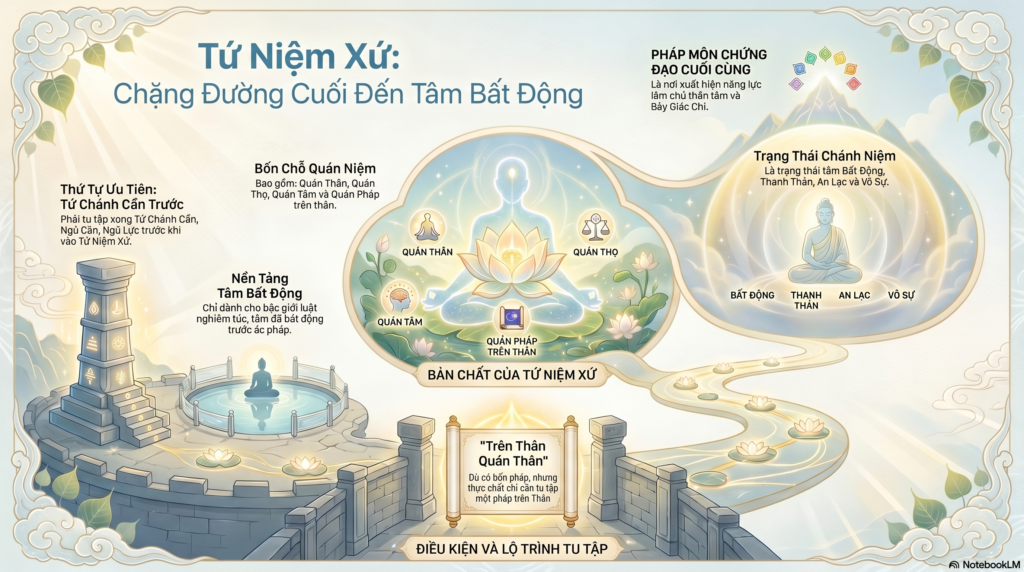
Tứ Niệm Xứ gồm có:
1- Quán thân trên thân
2- Quán thọ trên thọ
3- Quán tâm trên tâm
4- Quán pháp trên pháp
Pháp môn Tứ Niệm Xứ là một pháp môn tu tập để chứng đạo. Pháp môn này là một pháp môn rất quan trọng cho sự chứng đạo, nếu ai không tu tập pháp môn này thì không bao giờ chứng đạo, cho nên chúng ta cần phải thông suốt đường lối tu tập như thế nào đúng và như thế nào sai.
Một lần nữa chúng tôi xin nhắc quý vị: phải tu tập pháp môn TỨ CHÁNH CẦN, rồi sau mới tu tập đến pháp môn TỨ NIỆM XỨ, nếu không biết thì đừng tu tập, kẻo có tu tập thì chỉ uổng công mà thôi.
Đừng nghe nói pháp môn Tứ Niệm Xứ mà ham tu cao. Pháp môn Tứ Niệm Xứ dành cho những bậc giới luật nghiêm túc, dành cho những bậc tâm đã BẤT ĐỘNG trước các ác pháp và các cảm thọ, chớ không phải pháp môn này ai muốn tu tập là cũng tu tập được. Nếu quý vị tu tập mà không biết khả năng trình độ của mình thì đó là tu tập sai pháp, xin quý vị cần quan tâm.
Dưới đây là pháp môn Tứ Niệm Xứ, một pháp môn dành cho những người đã tu tập xong NGŨ CĂN, NGỮ LỰC và TỨ CHÁNH CẦN.
Tứ Niệm Xứ là pháp môn thứ sáu của Phật giáo, theo lời dạy của đức Phật còn ghi lại trong kinh sách Nguyên Thủy. Tứ Niệm Xứ theo BÁT CHÁNH ĐẠO thì nó là CHÁNH NIỆM. Vậy trạng thái Chánh Niệm như thế nào?
Trạng thái Chánh Niệm là một trạng thái tâm BẤT ĐỘNG, THANH THẢN, AN LẠC, VÔ SỰ, tâm luôn luôn tỉnh giác trên bốn chỗ THÂN, THỌ, TÂM, PHÁP. Cho nên Tứ Niệm Xứ gọi là TRÊN THÂN QUÁN THÂN. Tuy nói rằng trên thân quán thân, nhưng sự thật là trên THÂN quán cả bốn chỗ Thân, Thọ, Tâm, Pháp.
Tuy nói bốn pháp , chớ khi tu tập chỉ có tu tập một pháp TRÊN THÂN QUÁN THÂN mà thôi.
Pháp môn Tứ Niệm Xứ là pháp môn nhiếp tâm Bất Động cuối cùng của Phật giáo, vì chính người tu tập sống được với tâm Bất Động là đã chứng đạo. Ở đây không còn tu pháp môn nào khác nữa. Cho nên pháp môn Tứ Niệm Xứ được xem là pháp môn tu tập cuối cùng của Phật giáo gọi là CHÁNH NIỆM. Nơi đây tất cả năng lực làm chủ thân tâm sẽ được xuất hiện trên mảnh đất BẤT ĐỘNG. BẢY GIÁC CHI cũng xuất hiện đầy đủ trên tâm Bất Động này. Vì thế quý vị đừng vội vàng tu tập Tứ Niệm Xứ mà nên xét lại tâm mình đã Bất Động chưa, nếu tâm BẤT ĐỘNG thì mới tu tập TỨ NIỆM XỨ, còn chưa thì nên trở lại tu tập pháp môn TỨ CHÁNH CẦN.
Theo: 37 phẩm trợ đạo (Trưởng lão Thích Thông Lạc)
The Four Foundations of Mindfulness consist of:
- Contemplation of the body in the body (Quán thân trên thân)
- Contemplation of feelings in feelings (Quán thọ trên thọ)
- Contemplation of the mind in the mind (Quán tâm trên tâm)
- Contemplation of dhammas in dhammas (Quán pháp trên pháp)
The Four Foundations of Mindfulness is the practice for attaining Enlightenment (attaining the Way). This is a crucial practice for realization; without it, one can never achieve Enlightenment. Therefore, we must thoroughly understand which method of practice is correct and which is incorrect.
Once again, I must remind you: one must first practice the FOUR RIGHT EFFORTS, and only then proceed to the FOUR FOUNDATIONS OF MINDFULNESS. If you do not understand this, do not attempt to practice, lest your efforts be in vain.
Do not be tempted by the high reputation of the Four Foundations of Mindfulness and rush into advanced practice. This method is reserved for those who strictly observe the precepts and whose minds are already UNSHAKEABLE before unwholesome states and painful feelings. It is not a practice that just anyone can undertake at will. If you practice without knowing your own capacity and level, you are practicing incorrectly. Please pay close attention to this.
The following is the Four Foundations of Mindfulness, a practice intended for those who have completed the cultivation of the FIVE FACULTIES (Ngũ Căn), the FIVE POWERS (Ngũ Lực), and the FOUR RIGHT EFFORTS.
The Four Foundations of Mindfulness is the sixth practice of Buddhism, according to the Buddha’s teachings recorded in the Early Buddhist scriptures. Within the EIGHTFOLD PATH, it is RIGHT MINDFULNESS (Chánh Niệm). So, what is the state of Right Mindfulness?
The state of Right Mindfulness is a state of mind that is UNSHAKEABLE, SERENE, BLISSFUL, and AT EASE (Bất Động, Thanh Thản, An Lạc, Vô Sự), where the mind is always vigilant over the four areas: BODY, FEELINGS, MIND, and DHAMMAS. This is why the Four Foundations of Mindfulness is called “contemplating the body in the body.” Although it is stated as such, in reality, it involves using the BODY as a base to contemplate all four areas: Body, Feelings, Mind, and Dhammas.
Even though four areas are mentioned, the actual practice consists of only one: CONTEMPLATION OF THE BODY IN THE BODY.
The Four Foundations of Mindfulness is the final practice for maintaining an Unshakeable mind in Buddhism, for when a practitioner can truly live with an Unshakeable mind, they have attained Enlightenment. Beyond this, there are no other methods to practice. Thus, the Four Foundations of Mindfulness is considered the ultimate practice of Buddhism, known as Right Mindfulness. It is here that all the powers to master the body and mind will emerge upon the ground of UNSHAKEABILITY. The SEVEN FACTORS OF ENLIGHTENMENT (Bảy Giác Chi) also fully manifest within this Unshakeable mind. Therefore, do not rush into practicing the Four Foundations of Mindfulness. Instead, examine whether your mind is truly Unshakeable. If it is UNSHAKEABLE, then proceed to the FOUR FOUNDATIONS OF MINDFULNESS; if not, you should return to practicing the FOUR RIGHT EFFORTS.
💡 Thuật ngữ bổ sung (Additional Terms)
Dưới đây là các thuật ngữ mới xuất hiện trong đoạn này:
- Chứng đạo: Attaining Enlightenment / Realizing the Way.
- Giới luật nghiêm túc: Strictly observing the precepts / Disciplined in moral virtue.
- Ngũ Căn, Ngũ Lực: The Five Faculties, The Five Powers.
- Bát Chánh Đạo: The Noble Eightfold Path.
- Chánh Niệm: Right Mindfulness.
- Thanh Thản, An Lạc, Vô Sự: Serene, Blissful, and At Ease (hoặc Free from cares).
- Bảy Giác Chi: The Seven Factors of Enlightenment (Pali: Bojjhaṅga).
- Nhiếp tâm: Gathering the mind / Maintaining focus / Restraining the mind.